
Offshore Asset Protection
OFFSHORE ASSET PROTECTION LAWYER
OFFSHORE ASSET PROTECTION
- People who stand out as successful, wealthy individuals can become targets of unwanted lawsuits
- Directors or officers of a corporation who may get sued
- Individuals who place their assets under the names of family members
OFFSHORE TRUSTS
An offshore trust is the strongest form of asset protection. An offshore trust is a legal arrangement created in a foreign jurisdiction, outside the settlor’s home country, that involve transferring assets to a licensed trustee who assumes legal ownership and manages these assets. A creditor cannot force the foreign trustee to hand over assets, produce records, or comply with domestic court orders. The only path is to hire a lawyer in the offshore jurisdiction, post a $100,000 bond, and relitigate the claim under the rules that heavily favor the settlor.
In the Cook Islands, where most U.S. offshore trusts are established, no creditor has ever recovered assets through local proceedings. An offshore trust is the strongest asset protection structure available for people, CEOs, and businesses with substantial non-exempt wealth.
HOW DO OFFSHORE TRUSTS WORK?
An offshore trust is governed by the law of the country where it is established. The settlor signs a trust deed naming a licensed foreign trust company as trustee and transfers assets into the trust. Assets can move directly into the trust or into a holding entity, typically formed offshore also, which will be owned by the trust. Once funded, the trustee holds legal title and manages the assets under the terms of the trust deed.
The settlor is usually the primary beneficiary. The trust deed gives the trustee discretion over distributions, meaning the trustee decides whether and when to release funds. It’s the trustee discretion that makes the trust assets truly protected. If the settlor could withdraw assets at will, a court could simply order the withdrawal and redirect the funds to a creditor. The settlor can request distributions, and in ordinary circumstances the trustee honors those requests. But the trustee has no legal obligation to comply. When a lawsuit or creditor threat arise, the trustee’s ability to say “no” is the mechanism that keeps the asset out of reach.
TYPICAL STRUCRURE
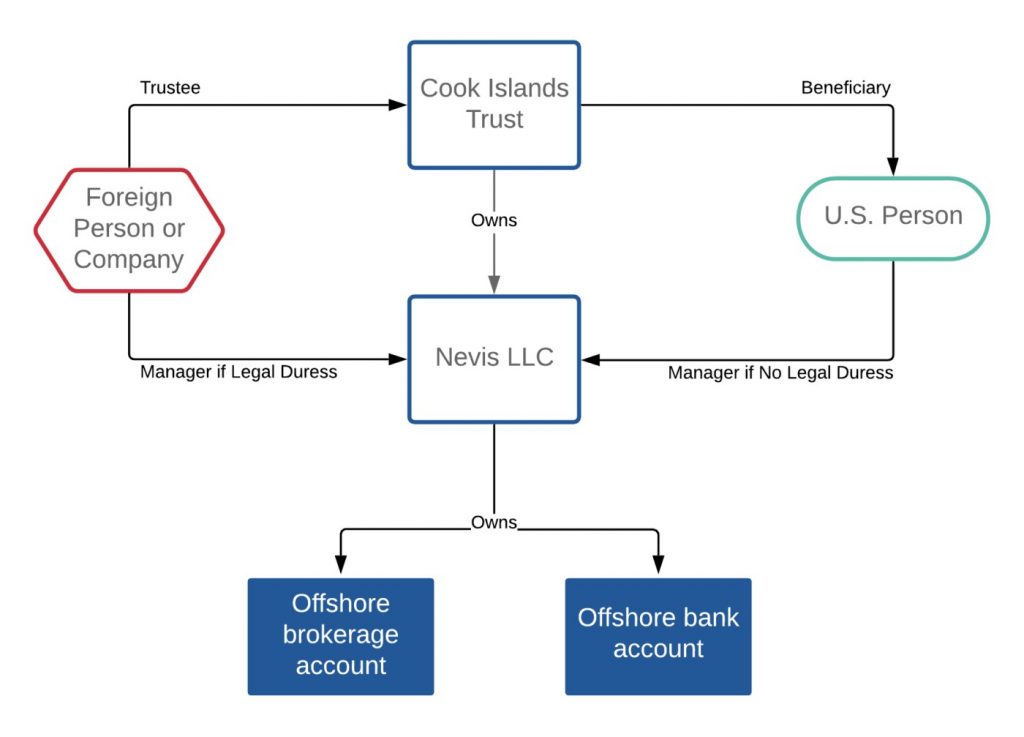
Most offshore trust plans pair a Cook Islands trust with a Nevis LLC or Cook Islands LLC. The trust owns 100% of the LLC. The settlor serves as manager of the LLC during ordinary times, keeping day-to-day control over investments and bank accounts held within the LLC.
When a creditor threat arises, the trustee removes the settlor as LLC manager and takes direct control, placing the assets beyond any U.S. court order. Once the threat passes, the settlor is restored as manager. The trust deed, LLC operating agreement, and trustee protocols govern exactly how this transition works.
The trust-over-LLC design gives the settlor practical control during normal life and shifts full authority to the offshore trustee only when protection is needed.
REQUIREMENTS FOR AN OFFSHORE TRUST
An offshore trust protects assets only when specific structural conditions are met. A plan that misses any of them is vulnerable to U.S. court enforcement.
- The trust must be irrevocable. A revocable trust offers no creditor protection because the settlor retains the power to demand the assets back, which a court can compel.
- The settlor cannot act as trustee. A settlor who holds trustee power can be ordered to act on the trust’s behalf.
- The trustee must be a licensed foreign trust company, not an individual and not a U.S. entity. Licensed trust companies in the Cook Islands and Nevis are regulated, bonded, and experienced in asset protection.
- The trustee must have discretion to withhold distributions. The anti-duress clause directs the trustee to refuse distributions when the settlor is under legal duress from a U.S. creditor.
- The trust protector, if any, must be located outside the United States. A U.S. based protector is subject to U.S. court jurisdiction and can be compelled to remove or replace the trustee.
- The choice-of-law clause must name the offshore jurisdiction. The trust deed must state that the laws of the Cook Islands or Nevis govern the trust’s validity and administration.
- Assets must move offshore or into an offshore entity controlled by the trustee. Assets physically located in the United States remain subject to U.S. court jurisdiction regardless of who holds title.
ADVANTAGES OF AN OFFSHORE TRUST
Offshore trusts provide four primary advantages: creditor protection, financial privacy, estate planning, and jurisdictional diversification.
- ·Creditor Protection. An offshore trust puts assets beyond a creditor’s practical reach by placing them under the control of a foreign trustee who does not answer to U.S. courts. The Cook Islands imposes a two-year statute of limitations on fraudulent transfer claims, requires proof beyond a reasonable doubt, and refuses to enforce foreign judgments.
In FTC v. Affordable Media (1999), a U.S. court held the settlors in contempt for failing to repatriate trust assets. The Cook Islands trustee refused to comply, and the assets remained protected. That case confirmed both the strength of the structure and the contempt risk, which is the primary tradeoff.
Financial Privacy. Offshore trusts are not listed in any public database. The trust deed is a private document executed in a foreign country. No U.S. public filing reveals who owns a Cook Islands trust or what assets it holds. The IRS knows about the trust through required tax filings, but creditors, business competitors, and the general public do not.
Estate Planning. An offshore trust directs how assets pass to beneficiaries at death without probate, and the creditor protection continues for the next generation.
Jurisdictional Diversification. A person whose entire net worth sits within the U.S. legal system is fully exposed to its courts and political environment. An offshore trust moves a portion of those assets to a country whose laws favor the asset owner.
DISADVANTAGES OF AN OFFSHORE TRUST
The major disadvantage of an offshore trust is the loss of control. The settlor gives up direct access to the assets. This is by design. When a court orders a settlor to repatriate assets, the defense is that the settlor genuinely cannon comply, at the trustee controls the assets and is not subject to U.S. jurisdiction. This protection and defense only work if the loss of control is real. Additional risk could involve poorly timed asset transfers that would create fraudulent transfer exposure.
WHO SHOULD CONSIDER AN OFFSHORE TRUST?
Offshore trusts are appropriate for individuals whose litigation exposure and asset level justify the cost. The people who benefit most hold $5,000,000 or more in assets, face above average creditor risk from their profession or business activities and have exhausted the domestic planning alternatives available in their state. Physicians, business owners, real estate investors, contractors, and other high risk professionals each face distinct liability patterns that share how the trust is structured and funded.
If you need help determining the best asset protection strategies, we can help. Timing is NOW. Contact us today to schedule your consultation. Becoming a business owner, you control your own destiny, choose the people you work with, reap big rewards, challenge yourself, give back to the community, and you get to follow your passion. Knowing what you’re getting into is smart business because the responsibility of protecting your business falls on you.

Kelly Bagla, Esq.
High Net Worth Business Attorney, Kelly Bagla is an international award-winning corporate lawyer and entrepreneur. Affectionately known by her clients as, “Queen of Business Law®,” Kelly protects high net-worth individuals and business owners through custom legal strategies.
Other Services
